Improve room acoustics: why rooms echo and what really helps
7 min read

A room can be perfectly furnished and still feel uncomfortable. As soon as two people start talking, words become hard to understand, every footstep sounds too loud, and a phone call turns into a test of patience. Room geometry also plays a role: unfavourable proportions can make low frequencies boom or create higher-frequency flutter echoes. But the everyday problems you actually notice—blurred speech and every sound seeming too loud—are mainly caused by hard surfaces and the reverberation they create. Both can be improved in a targeted way once you understand where the reverberation comes from.
Why modern rooms reverberate so strongly
Sound is movement through the air. You can picture it like a Newton’s cradle: when you move the outer ball, the impulse travels through the entire row while the balls in between barely leave their positions. In the same way, air molecules pass sound energy from one neighbour to the next without the air itself travelling across the room.
When this movement hits a surface, it is either absorbed or reflected. Hard, smooth materials reflect almost all of the sound, while soft and porous materials absorb it. Modern architecture relies heavily on hard, smooth surfaces: large areas of glass, exposed concrete, polished floors and bare walls. These materials look good—but acoustically, they are the problem.
Hard surfaces reflect almost everything
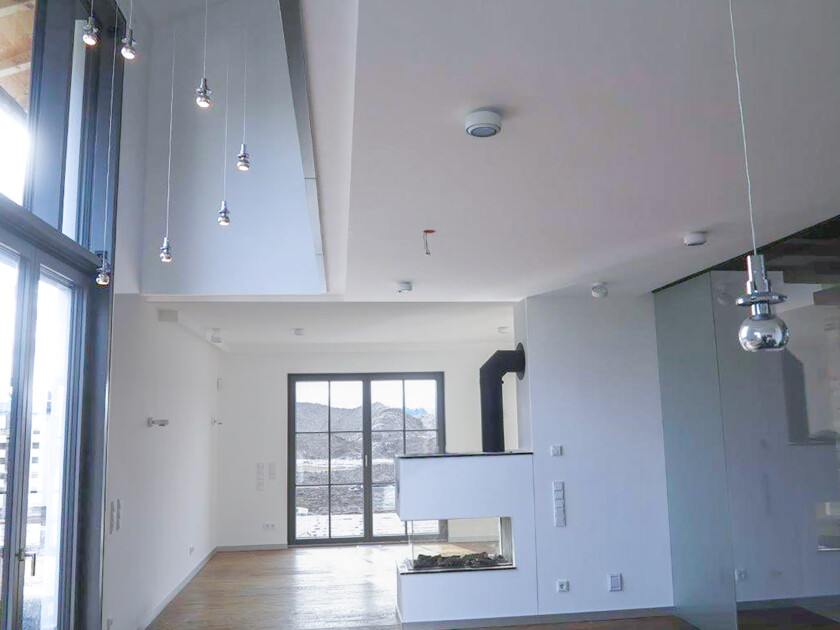
In a room with lots of glass and concrete, sound loses very little energy. It bounces from surface to surface, overlaps with itself and continues for a long time. Clearly spoken sentences turn into a blurred mix of sound because the original sound and its reflections reach the ear at the same time.
Reverberation time: the invisible measurement
Acousticians describe this using reverberation time. It indicates how long a sound takes to decay significantly. The longer this value, the more reverberant the room feels. Excessive reverberation makes speech difficult to understand and demands more concentration in everyday life—whether in a living room, restaurant or open-plan office.
What about the floor plan? Room modes and flutter echoes
A fair point: room geometry matters too. Standing waves, known as room modes, form between two parallel walls. The lowest mode occurs when exactly half a wavelength fits between the two surfaces.
It becomes critical when length, width and height have simple integer ratios. The modes of several axes then coincide at the same frequencies, reinforce one another and make some bass notes boom while others almost disappear. That is why rooms are deliberately planned with irregular proportions rather than as cubes or simple multiples.
The distinction matters in practice because the two problems require completely different solutions. A flutter echo is relatively easy to eliminate: interrupt one of the two parallel surfaces with an absorbing or diffusing surface.
What makes speech sound blurred and every noise seem too loud in everyday life belongs to the second group: broadband reverberation in the mid and high frequency range caused by hard surfaces. And that is precisely what absorbing surfaces remove from the room.
How to recognise a reverberant room
You often notice the problem before you can put a name to it. Typical signs include:
- Conversations become tiring and you have to concentrate in order to follow them.
- Voices sound harsh and overlap, especially when several people are speaking.
- Everyday sounds such as footsteps, dishes or a slamming door seem unpleasantly loud.
- Phone calls and video calls sound echoey, and the person on the other end has trouble understanding you.
- The room feels uncomfortable or uninviting, even though you cannot quite explain why.
What you can do immediately to reduce reverberation
Before moving on to a permanent solution, simple measures can already make a noticeable difference. The principle is always the same: replace or supplement hard surfaces with soft, sound-absorbing ones.

Add soft surfaces
- A large, thick carpet on a hard floor immediately takes some of the harshness out of the sound.
- Heavy curtains in front of glass surfaces noticeably reduce reflections.
- Open shelving with books and irregular objects helps diffuse sound.
- Upholstered furniture, cushions and fabrics work better than smooth leather or wooden surfaces.
The limits of quick fixes
These measures help, but they have clear limits. They work best in smaller rooms that are already well furnished. In large spaces with lots of glass, concrete and open ceiling area, a carpet alone is not enough to bring reverberation time noticeably under control.
When quick fixes are no longer enough
Once you are dealing with an open-plan kitchen and living area, a foyer, a medical practice or an open-plan office, you need a genuinely acoustically effective surface. The key question then becomes: how can I add enough absorption to the room without filling it with visible technical elements or panel grids? This is exactly where seamless acoustic plaster comes in.
The idea can be summed up with a simple image: the ideal sound-absorbing surface works like an open window through which sound leaves the room and does not return. We explain the principle of the acoustically open window and how it can be used to calculate the required absorption area in a separate article.
The permanent solution: seamless acoustic plaster
How acoustic plaster works
Seamless acoustic plaster is a multi-layer system applied directly to the ceiling or wall. Beneath a finely plastered surface is an open-pored, sound-absorbing layer. Sound enters this structure and is converted into heat instead of being reflected back into the room. This reduces reverberation time in a targeted and lasting way.
Why invisibility is an advantage here
The result looks like a normal, smooth ceiling while still absorbing sound. There are no visible edges, no grid and no shadow gaps. Especially in representative spaces, that is the crucial point: you get the acoustics you need without making the room look as though it had to be repaired afterwards.
Planning room acoustics: the most common mistakes
- Only addressing acoustics after the interior fit-out, once all the hard surfaces are already in place.
- Focusing only on appearance and not considering reverberation time at all.
- Planning too little absorbing surface and then wondering why there is hardly any effect.
- Adding visible panel solutions to a room where the architecture itself is meant to take centre stage.
Frequently asked questions about room acoustics
How can I improve the room acoustics in an existing room?
With soft, sound-absorbing surfaces. Carpets, curtains and upholstered furniture are a good first step. For a noticeable and lasting effect in larger rooms, seamless acoustic plaster on the ceiling or walls is the most effective solution because it creates a large absorbing area without being visible.
What is a good reverberation time for a living room?
For living spaces, short reverberation times of around half a second to one second are generally perceived as pleasant. The exact value matters less than the experience: conversations should be easy to understand and the room should feel calm.
Does a carpet alone help reduce reverberation?
Yes. A large, thick carpet noticeably takes some of the harshness out of the sound, especially on a hard floor. In small rooms, that may be enough. In large rooms with lots of glass and concrete, it is only a starting point: a carpet and curtains simply cannot provide enough “acoustically open window” area to reduce reverberation time sufficiently. And, to be fair, a carpet rarely fits a clean, modern Bauhaus aesthetic, while a curtain only provides its full surface area when it is closed.
Is acoustic plaster also suitable for private homes?
Absolutely. Especially in open-plan living areas with high ceilings and large glass surfaces, seamless acoustic plaster creates noticeably calmer acoustics without disrupting the design. A smooth, velvety surface such as the DEKOZELL® ACOUSTIC PLASTER SUPERSMOOTH is the perfectly invisible solution for outstanding architecture.
AI tools were used to support the creation of these articles. Content, selection, contextualisation and final editorial review remain the responsibility of Thomas Neubauer.