Reverberation time and DIN 18041 explained clearly
9 min read

Good room acoustics means one thing above all: hearing better.
When it comes to professional acoustics, two terms come up again and again: reverberation time and DIN 18041. They may sound technical, but they are easy to understand. Even the seemingly mysterious decibel is actually quite simple once explained.
With our DEKOZELL® Acoustic Calculator you can skip all the logarithmic charts in DIN 18041: with just a few inputs, you can go directly from room volume to the required acoustically open window and the appropriate reverberation time. These two values provide concrete acoustic targets for every type of room, from schools to concert halls.
What reverberation time actually means
Reverberation time describes how long a sound continues to linger in a room. It is measured as the time it takes for the sound level to fall by 60 decibels, hence the abbreviation T or RT60. The longer this value, the more reverberant the room.


A reverberation time that is too long makes speech difficult to understand, while one that is too short can make a room sound “dead”. The aim is therefore not to eliminate reverberation entirely, but to achieve the right value for the intended use.
Why the right reverberation time matters
Reverberation time directly affects speech intelligibility. In a classroom or meeting room with excessive reverberation, listeners have more difficulty understanding individual words, concentration drops and speakers have to strain their voices more. In a concert hall, by contrast, a certain amount of reverberation is desirable so that music sounds full and warm. The right value therefore depends on what the room is intended for.
What DIN 18041 specifies
DIN 18041 is the key standard for audibility in rooms. It distinguishes between two basic groups and derives target values according to room volume and intended use.
In the standard, these target values are read from logarithmic diagrams, matching a specific room volume with the corresponding reverberation time. A much easier way is to use our DEKOZELL® Acoustic Calculator: it uses the same DIN 18041 formulas in the background, but directly returns the required acoustically open window – in other words, the area that needs to absorb the sound.
Where this absorption area ultimately comes from – acoustic plaster or another solution – is up to you as the designer. Our calculator is deliberately manufacturer-neutral. Freely available tools like this are rare, because most online calculators are tailored to a particular supplier’s products and therefore restrict planning freedom. What matters most is that acoustics are considered from the very beginning, regardless of which solution ultimately provides the absorption.
Group A: Rooms for communication
This group includes rooms where speech and communication are the priority, such as classrooms, meeting rooms, lecture halls or courtrooms. For these spaces, the standard defines a target reverberation time based on room volume and type of use. As a general rule, the more important speech intelligibility is, the shorter the required reverberation time.
Group B: Rooms requiring noise control
This group includes rooms where the main concern is not presentations but limiting noise, such as open-plan offices, canteens, foyers or workshops. Instead of specifying an exact target reverberation time, the standard defines requirements for the amount of absorbing surface relative to the room.
Special case: Sports halls and swimming pools
DIN 18041 treats sports halls and swimming pools as a special case: large volumes, many hard surfaces and often several groups using the space at the same time create particular acoustic demands. If events with an audience take place, the hall is acoustically treated as a speech space because announcements need to remain intelligible. Without an audience, the standard distinguishes between different types of use, shown in the DEKOZELL® Acoustic Calculator as Sport 1 and Sport 2:
- Sport 1: normal use or single-group teaching, meaning one class or sports group with the same communication content. Everyone in the room is listening to the same thing, so the acoustic requirement is comparatively moderate.
- Sport 2: multi-group teaching, where several groups are active at the same time. Because the noise from parallel activities adds up, significantly more absorbing surface is required.

The following values are rough guidelines and do not replace a room-acoustic calculation, but they give an idea of the relevant range:
Strictly speaking, for Group B rooms such as foyers the standard does not specify a target reverberation time, but rather a target amount of absorbing surface. The value above is therefore only intended as a rough guide.
If you move into a new villa, stand in the kitchen and feel as though you are inside a reverberant church, the designer would have been better off considering DIN 18041 from the outset. The standard is not mandatory for private homes, so good acoustics remain a matter of choice. But luxury is not compulsory either: if you want it, you have to plan for it. And this applies to much more than villas. Nobody wants their home to sound like a railway-station waiting room, yet that is exactly what can happen when acoustics are considered too late.
How much absorbing surface does a room need?
For a room to achieve the target values, enough sound has to be absorbed. The amount of absorbing surface required depends on the room volume, its use and the materials already present. In a large room with many hard surfaces, a small measure will not be enough. What is needed is an effective, preferably large absorbing area – ideally on the ceiling, because it is usually both unobstructed and extensive. The exact amount required can be calculated by the DEKOZELL® Acoustic Calculator in just a few clicks based on room volume and use.
The principle of the acoustically open window and the Sabine formula: room volume and target reverberation time are used to determine the required equivalent absorption area in square metres – the planning basis for any solution designed in accordance with DIN 18041.
From the standard to the solution: seamless acoustic plaster
Seamless acoustic plaster provides exactly this large, effective absorption area without overlaying the architecture with visible acoustic elements. This is made possible by an open-pored structure: sound enters the surface and is converted into heat instead of being reflected back into the room. The surface remains visually smooth while still absorbing sound.
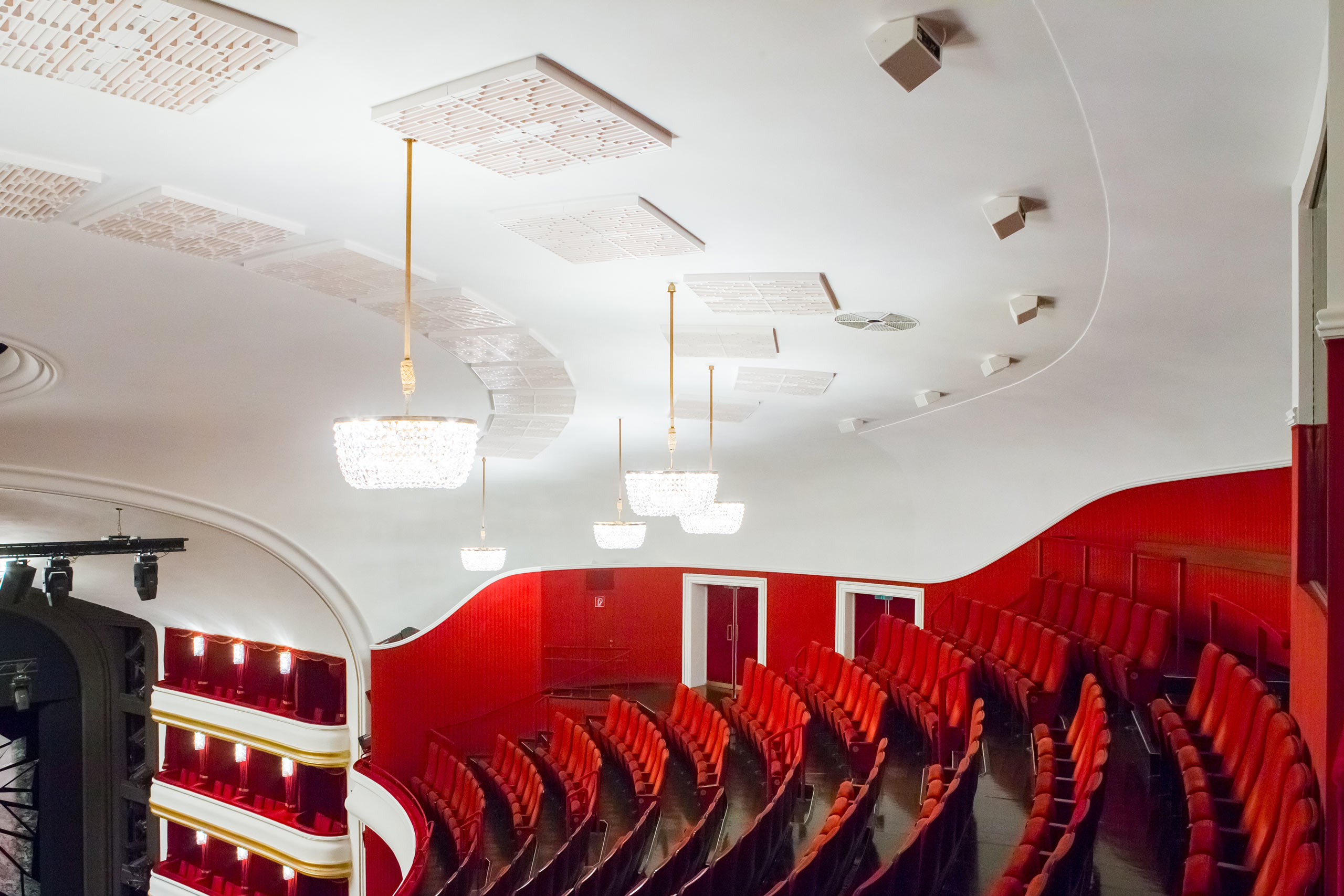
One clear advantage over panels is that, because the plaster is applied seamlessly, it can follow curved or complex surfaces where rigid panels reach their limits. A velvety smooth finish such as DEKOZELL® ACOUSTIC PLASTER SUPERSMOOTH brings this effect to large ceiling and wall areas and can later be repaired and renovated with virtually invisible results. The Volksoper Viennademonstrates that this also works under the highest demands. There, the DEKOZELL® System FLEXOPANEL is used to dampen a large, highly reflective cove. The system follows its curved shape effortlessly and remains almost invisible within the auditorium.
For a comparison of whether plaster or panels are the better fit in a particular project, see Acoustic plaster or acoustic panels ; for the fundamentals of why rooms reverberate in the first place, read Improve room acoustics.
Common room-acoustics planning mistakes
- Only addressing acoustics after completion – retrofit solutions can quickly cost many times more than measures planned from the outset.
- Ignoring DIN 18041 and relying solely on intuition.
- Planning too little absorbing surface and missing the target values.
- Treating only the walls and leaving out the ceiling, even though the distance between ceiling and floor is usually the shortest dimension in the room and therefore one of the most frequent paths for sound reflections.
Frequently asked questions about reverberation time
What does RT60 or T mean?
Imagine clapping your hands loudly in a large, empty hall. The clap itself is over immediately, but you continue to hear it reverberate through the room for a moment before it becomes quiet again. That period – the time a sound takes to decay from loud to almost silent – is the reverberation time. Technically, specialists measure the time it takes for the sound level to drop by 60 decibels after the source is switched off, from clearly audible to barely perceptible. This value is called RT60 or T and is one of the most important measures of a room’s acoustic quality. The longer the reverberation time, the more reverberant the room sounds.
Does DIN 18041 also apply to private homes?
It is primarily relevant as a standard for public and commercial spaces. For private homes, however, it still provides useful reference values for creating pleasant room acoustics.
What is the most effective way to reduce reverberation time?
By providing enough absorbing surface. Seamless acoustic plaster on the ceiling is particularly effective because it turns a large area into an acoustically active surface without becoming visually prominent. If this is not sufficient at low frequencies, the DEKOZELL® DISTANCE-Easy acoustic plaster system can be configured as a concealed low-frequency absorber.
Can reverberation time be calculated in advance?
Yes. The Sabine formula can be used to calculate the required equivalent absorption area from the room volume and target reverberation time before construction begins. We explain how this works in detail in our article on the acoustically open window.
AI tools were used to support the creation of these articles. Content, selection, contextualisation and final editorial review remain the responsibility of Thomas Neubauer.